
How cream and powder blushes behave on textured skin
Advertisements
Cream and powder blushes behave differently on textured skin because their binding agents, pigment loads, and light-reflective qualities interact directly with the physical peaks and valleys of the face. Cream formulas rely on emollients that flex with skin movement and keep surface layers supple, while powder formulas rely on dry mineral particles that sit atop pores to absorb moisture and soften shine.
Understanding these distinct physical behaviors helps anyone dealing with enlarged pores, post-acne indentations, active breakouts, or dry patches choose the right cosmetic finish without exacerbating surface irregularities. The catch is that neither formula is universally superior for every type of texture, meaning the ideal choice depends on whether your texture consists of raised bumps, sunken scars, or surface flaking.
The physical mechanics of skin texture and light reflection
Visual texture on the face is largely an optical phenomenon caused by how ambient light hits surface variations. Smooth skin behaves like a uniform plane, bouncing light back at consistent angles to create what the human eye perceives as a soft, even glow. When skin has texture—such as the raised rims of enlarged pores, cystic bumps, keloid scars, or pitted atrophic scars—light strikes these uneven boundaries and casts microscopic shadows. These tiny drop shadows define the depth and visibility of texture far more than the color of the skin itself.
Advertisements
Color cosmetics alter this optical balance by introducing pigments, binders, and reflective minerals onto the surface plane. If a cosmetic product increases specular reflection—which is high-shine, mirror-like bounce—it draws attention to every raised point because the highest peaks of the skin reflect the brightest glare, while the valleys remain in relative darkness. Conversely, diffuse reflection scatters light in multiple directions, diminishing shadows and softening the overall appearance of the skin surface.
When selecting a blush for textured skin, the goal is always to control this light bounce. A product that floods the cheeks with heavy sheen will inadvertently map out every pore, while a product that is completely flat and dry can cause dead skin cells and peeling edges to stand upright. Balancing emollience and powder density is the foundation of achieving smooth color payoff on complex skin surfaces.
How cream blush formulas interact with uneven surfaces
Cream blushes are formulated primarily with waxes, oils, and synthetic esters that suspend pigment in a semi-solid or fluid emulsion. Because these ingredients do not dry down immediately into a rigid layer, they maintain physical flexibility throughout the day. On skin that features dry texture, fine lines, or dehydration-induced flaking, a cream formula helps soften rigid keratinized skin cells, preventing the cosmetic pigment from catching on rough, jagged edges.
Advertisements
However, the fluid nature of cream blushes presents specific mechanical challenges when applied over oily, porous, or scarred areas. Highly emollient creams remain mobile on the surface, which means facial expressions and natural sebum production can cause the pigment to migrate. Over several hours, cream products often pool into indentations, such as ice-pick or boxcar acne scars, while sliding off raised, oily bumps.
Characteristics of cream formulas on irregular skin
- Emollient integration: Plant oils and synthetic esters moisturize and flatten raised, dry flakes rather than catching against them.
- Surface mobility: Unset creams can shift during natural facial movement and gather inside deep pores or fine lines.
- Specular highlights: Dewy finishes generate localized shine that can emphasize the apex of raised blemishes and cysts.
- Base disruption: Stippling or rubbing creams over foundation can lift underlying concealer, exposing underlying redness.
To use cream formulas successfully on uneven surfaces, you must evaluate the dry-down speed and finish of the product. Modern cream-to-powder formulations or satin-finish cream sticks contain volatile silicones like dimethicone or isododecane that evaporate after application, leaving behind pigment that adheres firmly without leaving a greasy, highly reflective residue.
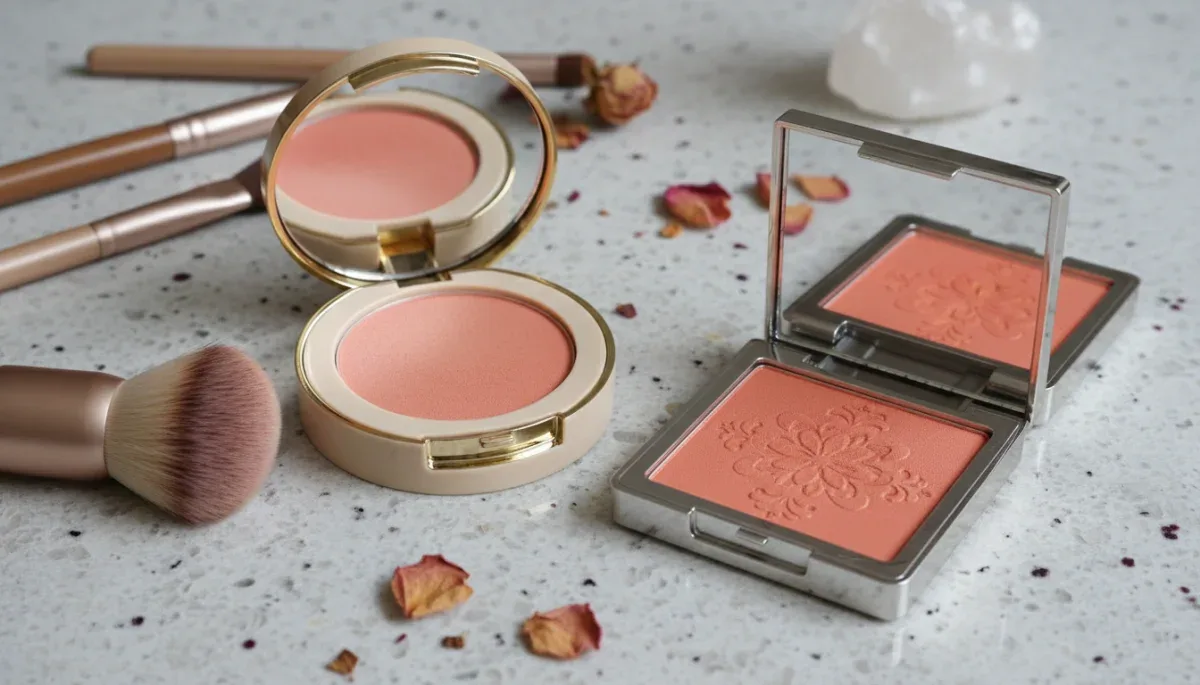
How powder blush formulas settle and set on pores
Powder blushes consist of dry pulverized minerals—such as mica, talc, silica, and boron nitride—compressed with binding agents to form a cake or loose powder. When pressed onto the skin, these microscopic dry particles absorb surface sebum and form a cohesive veil over the stratum corneum. For individuals with oily skin and enlarged, open pores, finely milled powders often provide a blurring effect by diffusing light evenly across the cheek plane.
Despite their oil-absorbing benefits, traditional powders carry distinct risks for textured complexions. Dry particles naturally adhere to areas with moisture or oil, but if the skin is parched, powder particles cluster unevenly around dry flakes, creating a chalky, magnified texture. Furthermore, if a powder blush is applied heavily over atrophic scars, the dry cake can sink into the base of the depression, emphasizing the contrast between the scar tissue and surrounding skin.
Powder behaviors across different texture profiles
- Sebum absorption: Matte minerals soak up facial oils, keeping the surface flat and minimizing shine on raised pore walls.
- Particle clustering: Coarse powders gather around peeling skin and scabbed blemishes, making dryness significantly more visible.
- Mechanical fill: Finely milled spherical silica can fill shallow surface valleys, acting as a temporary leveling compound.
- Longevity over oils: Powder structures resist movement over active sebaceous glands better than oil-rich creams.
The performance of powder blush for textured skin depends heavily on the grade of milling. Cheaper, coarsely ground powders sit noticeably on top of the skin like grains of sand, whereas micro-milled powders melt slightly into the skin's natural oils, forming a seamless wash of color that maintains a natural epidermal look.
The role of particle size and shimmer versus matte finishes
Beyond the choice between cream and powder vehicle bases, the finish of the blush exerts the most powerful influence on visible skin texture. Shimmer, glitter, and frosted finishes are created by coating mineral mica, synthetic fluorphlogopite, or bismuth oxychloride particles with titanium dioxide or iron oxides. These platelike particles sit on the surface of the skin and act as thousands of microscopic mirrors designed to reflect concentrated light directly back at the viewer.
When mica plates land on a smooth, flat cheekbone, the result is a luminous, lifted sheen. But when these same reflective plates settle across an area of active breakouts, enlarged pores, or rough scarring, each particle illuminates the edge of the texture imperfection. Frost and metallic finishes are particularly unforgiving, as their broad reflective planes exaggerate depth discrepancies across the dermal canvas.
Matte and satin finishes behave with far greater discretion on uneven surfaces. A true matte finish absorbs light, effectively flattening the visual plane and masking depth. However, totally flat matte shades can occasionally look mask-like or lifeless on dry skin. A soft satin finish—which contains a low ratio of micro-fine, light-scattering spherical powders rather than reflective mineral flakes—provides dimension while preventing the harsh shadow play that highlights pores.
Strategic skin prep to smooth texture before color application
No blush formula can perform optimally if the underlying skin surface is improperly prepared. Textured skin often presents a dual challenge: localized dehydration on the surface combined with excessive sebum production in the pores. If you apply color cosmetics directly over unprepped skin, pigment particles will inevitably separate, cling to dry patches, or dissolve in oil patches within hours.
Preparation begins with gentle chemical hydration rather than aggressive physical scrubbing. Rough manual scrubs create micro-tears and cause surrounding tissue to swell, which actually makes pores and scars look more pronounced. Instead, lightweight humectants such as glycerin and low-molecular-weight hyaluronic acid draw water into the upper layers of the epidermis, plumping the skin cells surrounding pores and softening dry edges.
Following hydration, targeted priming agents can bridge the gap between irregular skin topography and colored pigments. Primers formulated with cross-linked polymers, such as dimethicone or cyclopentasiloxane, fill in depressions without blocking sebum production entirely. These silicone elastomers create a temporary, flexible barrier that allows both cream and powder blushes to glide over pores rather than falling into them.
Application techniques that avoid disturbing base layers
The mechanical motion used to apply blush to textured skin is just as critical as the product formula itself. Traditional sweeping, swirling, or buffing motions with a dense brush drag bristles across the face, lifting up the microscopic edges of dead skin cells and peeling scars. This friction also displaces any underlying foundation or primer, gathering the base products into ridges around pores.
To avoid lifting surface texture, professional makeup application relies on pressing, rolling, and stippling techniques. When working with cream blush, use a dense, flat-topped synthetic brush or a damp beauty sponge to gently press the pigment onto the cheeks. Patting color into place ensures that the product bonds with the underlying base makeup rather than shearing it off or pushing pigment into deep indentations.
For powder applications, a soft, loosely packed natural or high-grade synthetic brush yields the smoothest finish. Rather than sweeping the brush back and forth, tap excess powder off the bristles and lightly press the flat side of the brush head against the skin. This deposition technique lays mineral powders flat against the face, allowing them to veil pores and scars without snagging on rough edges.
At a glance
| Factor | What to know |
|---|---|
| Raised blemishes | Matte powders scatter light and prevent shiny focal points on bumps. |
| Dry, flaking patches | Emollient cream formulas soften rigid flakes and prevent chalky buildup. |
| Enlarged pores | Micro-milled satin powders blur pore openings without settling into pockets. |
| Atrophic scars | Avoid shimmery creams that pool inside indentations and deepen shadows. |
Frequently asked questions
Can I use cream blush if I have large pores?
Yes, but you should choose a cream-to-powder or soft-matte formulation rather than a dewy one. Highly reflective, oily cream blushes catch light and emphasize the depth of pores, whereas semi-matte creams melt into skin without adding distracting shine.
Why does powder blush look patchy on my texture?
Powder blush looks patchy when dry mineral particles cling to dehydrated patches or mix unevenly with unabsorbed facial oils. Exfoliating gently with chemical acids and applying a light moisturizer before base makeup creates an even surface for powder adherence.
Is it better to apply blush with fingers or a brush on textured skin?
A damp makeup sponge or a soft stippling brush works best for textured skin. Fingers can transmit natural oils and exert uneven dragging pressure, which lifts dry skin flakes and disturbs your underlying base foundation and concealer layers.
Should I set cream blush with translucent powder if I have scars?
Yes, lightly pressing a finely milled translucent setting powder over cream blush prevents migration. Ensure the powder is applied with a gentle press-and-roll motion using a velour puff, avoiding excess build-up that could settle into scar depressions.
The bottom line
Cream and powder blushes both have a viable place in a routine for textured skin, provided their finishes, binders, and optical reflections are matched to your specific dermal concerns. Creams excel at moisturizing dry, flaking skin, while powders excel at absorbing excess shine over large pores. The one thing to verify before buying any formula is its finish on the product packaging; ensure it is strictly matte or soft satin, avoiding high-mica shimmers that reflect light unevenly across your cheeks.
Written by
Maria Teixeira
Maria Teixeira writes about clothes, makeup and benefits for bestinyour.com. Each article explains how things work, compares published details such as prices, policies and program rules, and points readers to the official source before they decide.